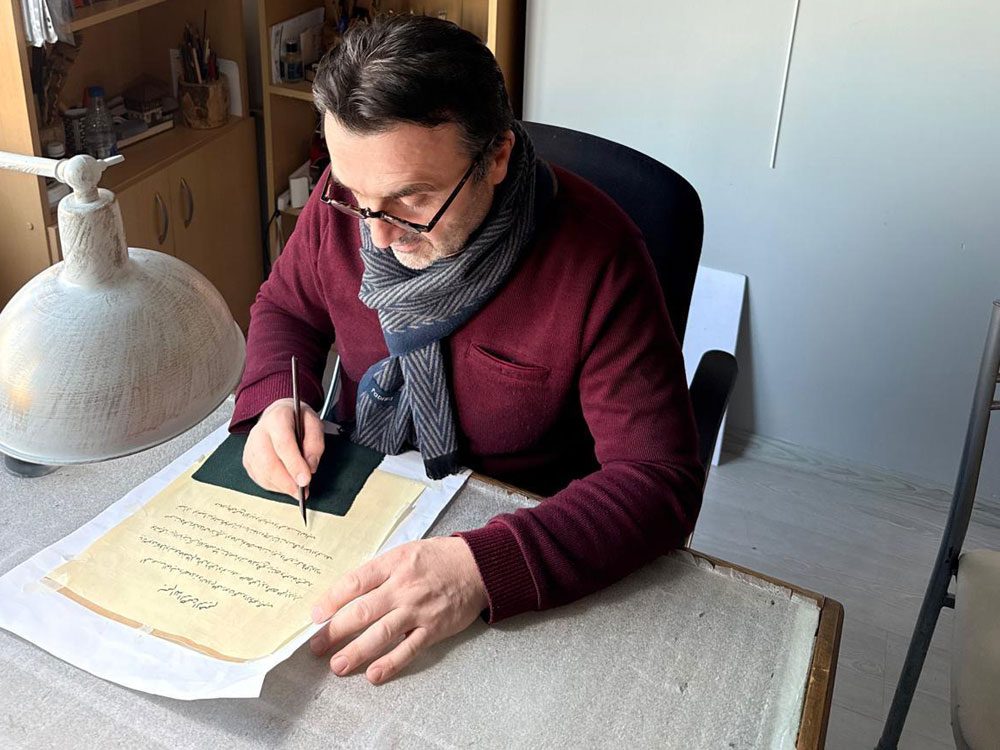
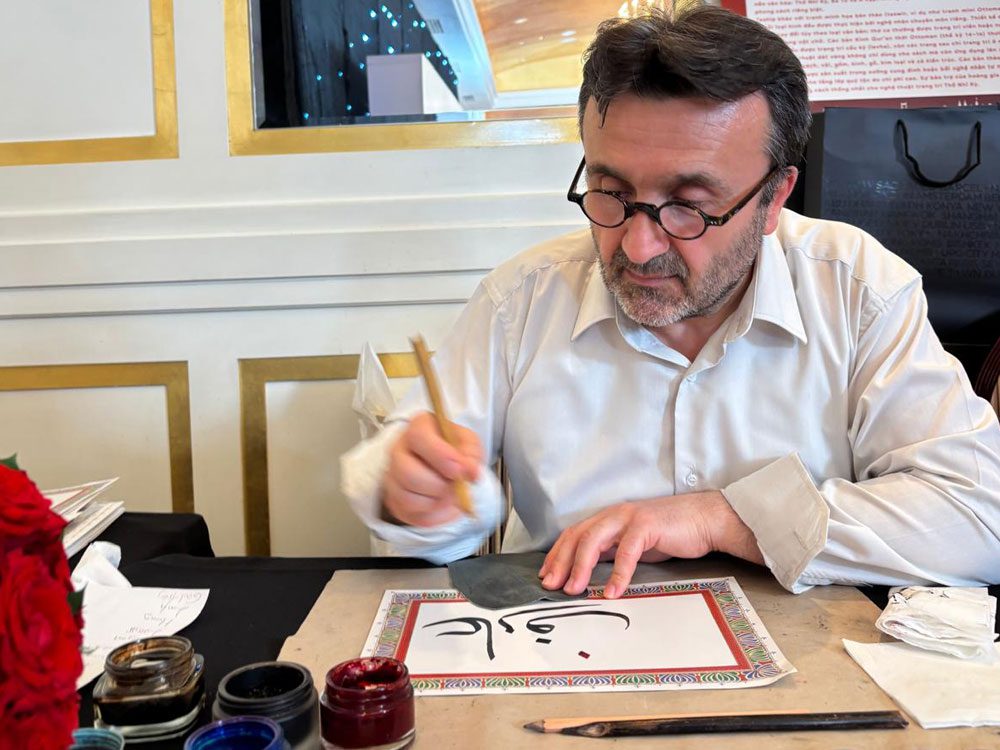
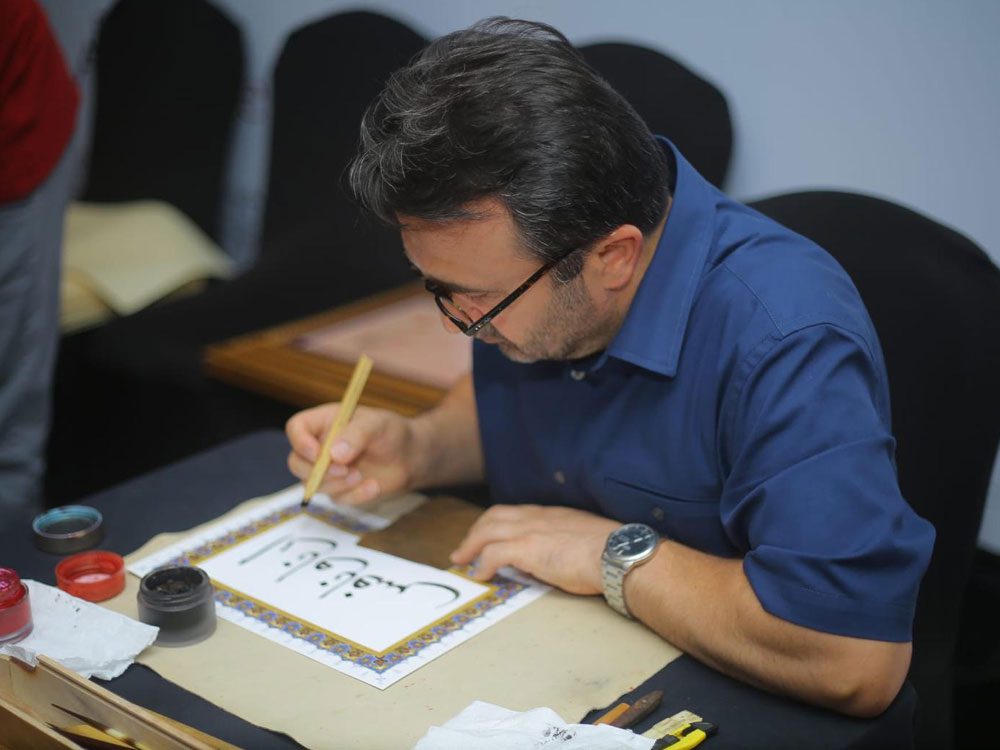
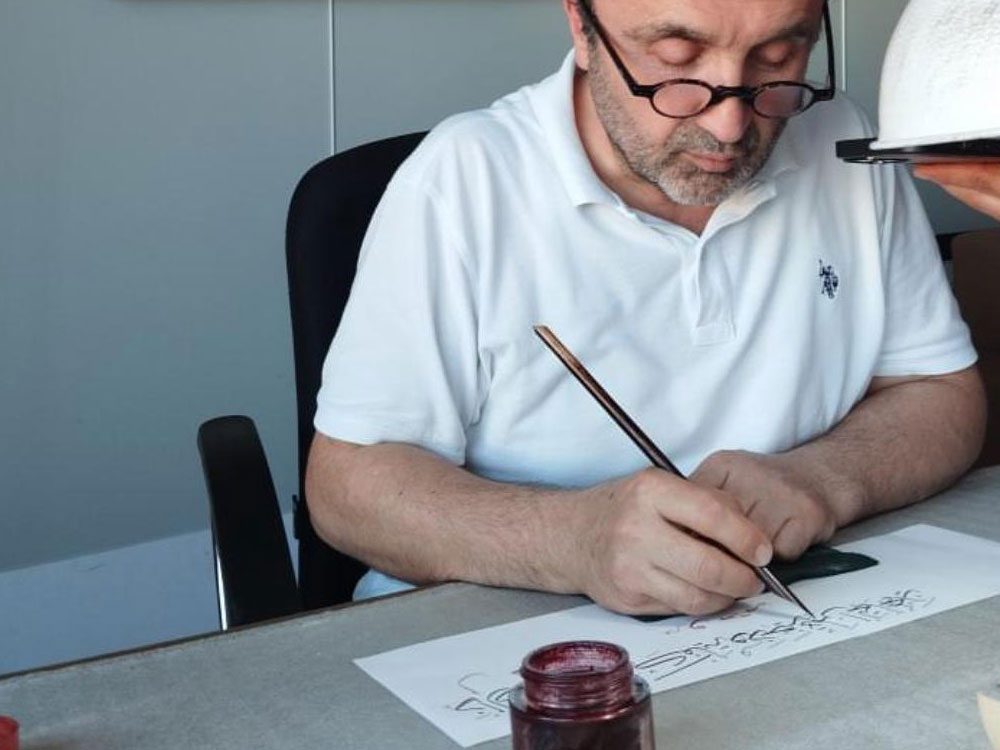
Deen Arts Foundation South Africa is dedicated to the traditional pedagogy of the Ijaazah system, which has preserved the Islamic sciences for the past 1400 years through a master-student-apprentice relationship which ensures that the highest level of mastery is retained as knowledge passes to the next generation. The current and past master calligraphers, manuscript illumination artists, geometers, and munshids associated with Deen Arts Foundation South Africa have all learned through the Ijazah system.
Haji Noor Deen Mi Guang Jiang
Haji Noor Deen Mi Guang Jiang, from China, is a renowned master of Arabic calligraphy and is responsible for the formal codification of the ancient Arabic writing system in the Chinese tradition. He is listed as one of the 500 Most Influential Muslims in the world. His work has been displayed in galleries and museums worldwide, including the British Museum, the Asian Art Museum of San Francisco, the National Museum of Scotland, and the Center for Government and International Studies (CGIS) at Harvard University. He was also awarded the Dubai Islamic Economy Development Center 2016 Islamic Economy Award in the category of Islamic Arts.
Shahryanshah Sirajuddin
Hoca Shahryanshah Sirajuddin, originally from Indonesia now based in Turkey, is a multi-award-winning master calligrapher in the Osmanli (Ottoman) tradition of the Riqa, Diwani, Jali Diwani, Naskh, Thuluth, and Jali Thuluth scripts. Prior to moving to Turkey, he completed studies in the faculty of law at the Al-Azhar University in Egypt as well as receiving his Ijazah for Riqa, Diwani and Diwani Jeli scripts from renowned Master Shaykh Belaid Hamidi. He studied Ottoman scripts (Thuluth and Naskh) under the guidance of a number of masters such as the world renowned Hasan Çelebi, Ferhat Kurlu, Mümtaz Seçkin Durdu, Savaş Çevik, Ali Toy, Davut Bektaş, Mehmed Özçay, and Osman Özçay.
Hafida Boulafrah
Ustaadha Hafida is a Moroccan illumination and calligraphy artist, trained at the prestigious Academy of Traditional Arts in Casablanca and Collège LaSalle International. As an illumination artist, she specialises in floral and geometric ornamentation, drawing inspiration from the rich architectural heritage of Morocco and Andalusia. She holds a specialist degree in Arabic calligraphy and ornamental design, along with a qualification in interior design—further enhancing her ability to merge traditional artistry with contemporary aesthetics.
Her artistic journey has led her to participate in numerous national and international exhibitions, where she has showcased her work to global audiences and contributed to the growing appreciation of both traditional and modern ornamental design.
Farzana Razzaque
Ustaadah Farzana Razzaque, based in the United States of America, is the Calligraphy and Tezhip Programme Director at Deen Arts Foundation (International). She is a graduate of the School of Architecture at the University of Texas at Austin. Following her interests in the arts, she has been studying calligraphy and tezhip for a number of years now. In 2021, she received her Ijazah, the permission to teach the Thuluth and Naskh scripts in the Ottoman tradition, from Master Calligraphers Haji Noor Deen Hoca and Ahmet Kutluhan. Ustaadah Farzana is also an advanced Tezhip student of Ustaadah Fatma Ulusoy Sirajuddin, with her works displayed in various exhibitions in the United States of America.
Dr Serap Ekizler Sönmez
Dr Serap Ekizler Sönmez, from Turkey, is a historian and specialist in Islamic geometric patterns. Serap’s breadth of knowledge stems from her extensive travels to notable Islamic heritage architectural sites with exemplary geometric patterns. Her exposure derives from visits to Iran, Uzbekistan, Azerbaijan, Kazakhstan, Egypt, Morocco, and India, notwithstanding her immersion and first-hand experience in her native country, Türkiye. In addition, her expertise in the theological and historical analysis of geometric patterns extends to considerable academic research. Serap’s PhD dissertation titled “The History of Geometric Patterns in Turkish and Islamic Art: Methodology, Applications, and Analysis in the Context of the Topkapi Scroll,” is a monumental work that pioneers a complete understanding of the subject matter. She taught courses for the Prince’s School of Traditional Arts (London) and other significant foundations. Serap is the Islamic Geometric Pattern (IGP) Programme director for Deen Arts Foundation (International). She has written valuable academic papers and distinguished books. Dr Sönmez also works as a researcher at FSM University- KURAM (Foundation Cultural Heritage Conservation Application and Research Center).
Fatma Ulusoy Sirajuddin
Fatma Ulusoy Sirajuddin, from Turkey, is a certified Tezhip Master teacher from Turkey who studied under the renowned Tezhip Master Ayşe Gülcan Özbalak since 2015. Her work has adorned the compositions of several master calligraphers, and she has participated in multiple tezhip exhibitions.
Ahmet Kutluhan
Born in 1975 in Kastamonu, Ahmet Kutluhan is a distinguished Turkish Islamic calligrapher whose artistic journey began during his high school years with the study of the Riqʿa script. In 1992, he moved to Istanbul to pursue higher education at the Faculty of Theology at Marmara University, while simultaneously undertaking formal calligraphy training. During this period, he studied the Thuluth and Naskh scripts under the renowned master Hasan Çelebi. After six years of intensive apprenticeship, he was awarded his ijazah (licence) in Thuluth and Naskh in 1998 at a ceremony organized by IRCICA.
Kutluhan went on to further refine his skills by studying Riqʿa with Prof. Dr. Muhittin Serin, and Jali Diwani and Taʿliq with Prof. Dr. Ali Alparslan. Following Alparslan’s passing in 2006, he continued his Taʿliq studies with Hasan Çelebi and received his Taʿliq ijazah in 2010, once again under IRCICA. Throughout his career, he has participated in over 100 group exhibitions and has held numerous solo exhibitions, including major shows in Istanbul in 2005 and 2015, as well as internationally across Europe, Asia, and Africa. Together with his 42 licensed students, he has organized six exhibitions throughout Turkey. His works adorn mosques and prayer halls worldwide and are held in private and institutional collections. He continues to teach and produce work in Üsküdar, Istanbul, where he maintains his studio.